For the Sickos: Notes on "Salò"

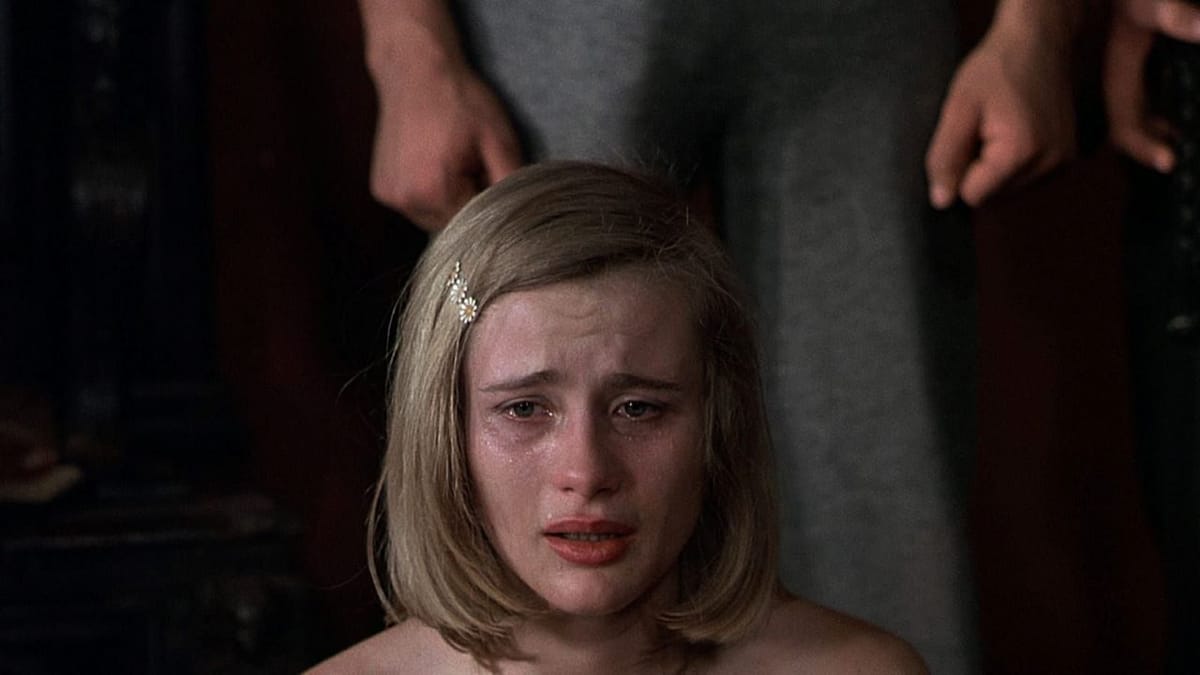
I've been thinking more about Salò lately.
If you've seen the film, there's a good chance you understand why already. It's a film steeped in the cruelty and callousness of fascism, and since we're surrounded by that all over again right now, the film keeps creeping back into my head. I saw it for the first time last year, during one of my periodic bursts of extreme horror viewings, and I remain in awe of its powers.
It's not a pleasant film in any sense, and that's precisely the point. Pier Paolo Pasolini's final feature (he was brutally murdered shortly before its release, adding a layer of menace to the whole thing) doesn't imbue his antifascist Marquis de Sade adaptation with much in the way of character-driven tension or even the bells and whistles of arthouse cinema production. There's not much ornamentation to it, because Salò wants you to understand, eventually, that no relief is coming, for you or for its characters. It's a masterclass in depicting the banality of evil, with an emphasis on the banality.
The plot, inasmuch as there is one, follows a group of fascist libertines who, over a period of several days, set out to systematically dehumanize a group of youths, some of them collaborators in the madness. It's framed as something almost educational for these youths, a chance for them to prove themselves on a grand stage, a chance to grasp the hands of the wealthy and powerful, those with the capacity to save them. But there is no salvation here but death, no survival but supplication.
Salò is famous as the film in which its characters, some of them quite willingly, dine on plates of human excrement. Ask anyone what they know about the film, and that's probably what you'll hear first. It's a factoid that suggests you are about to see something full of relentless shocks, an extreme horror thrill ride that'll test your stomach and your brain at the same time. But Pasolini gives us none of that.
The Republic of Salò in which the film is set was a Nazi puppet state established so Italian elites loyal to the fascist cause could at least pretend to cling to power even as their own people sought to overthrow them and the Allied army crept up the Italian peninsula. It will crumble, as rest of the Axis Powers of World War II crumbled, which adds a layer of apocalyptic drama to the whole thing. Adolf Hitler eventually committed suicide, in part, because he knew what happened to Mussolini, whose body was defaced and beaten beyond recognition in a public, cathartic spectacle for the Italian people. That is the path The Republic of Salò, a government entity for less than two years. You can feel the walls of this grand country house closing in on these people, and yet their behavior persists. It's context that only adds to the haunting impact of the film.
Is Salò a horror film that'll make you cringe, retch, and possibly slip out of the room a few times so you don't have to watch every frame? Definitely, but the secret to its devastating impact is not in anything that would limp it with, say, A Serbian Film, or Inside, or Calvaire. It is a film deliberately stripped of as much humanity as Pasolini could stand to flay off, because it is a film designed to hit you with the full force of unremarkable evil. The extremity of the violence and depravity is there, but it's all presented in such a staid, ritualistic way that, like the victims at the center of the story, it wears you down, makes you sink into its darkness, and reminds you that such darkness is not confined to history. It is ever-present, the excrement on fine dinnerware, and it will take you too if you let it.